7 Best Returns Donation Platforms for Fashion Retailers
Retail shoppers return roughly one in four clothing items they buy online, and many of those garments come back worn or with the tags removed. According to NRF survey data, 47% of online shoppers have returned an item with tags removed, and 32% have returned a worn one. Stained, tried-on, or out-of-season pieces pile up in warehouses, eating into margins and heading to landfills. Returns donation software routes those unsellable items directly to nonprofits, cutting reverse logistics costs.
At LiquiDonate, we care about one thing: that perfectly usable items don’t end up in the landfill. Since so many people have a deficit of basic needs, and others have a surplus, we choose to bridge this gap with donation. With modern technology, donating in bulk has become easier than ever before. We are proud to support companies that make retailer donation easier for a more circular economy.
This listicle compares the top platforms built for donation-first returns, with clear criteria so your operations and sustainability teams can make a confident pick.
Quick guide: 7 best returns donation platforms for fashion retailers
- Good360: Nonprofit-run marketplace connecting corporate donors with vetted organizations at scale
- DONE Solution: European platform linking surplus stock from brands to charities through a managed matching process
- Rewise: Reverse logistics tool with a resale-first model and a secondary donation pathway
- Give Back Box: Shipping-box reuse program that lets customers drop off donations through prepaid labels
- Loop: Exchange-first returns platform that integrates with LiquiDonate to route unsellable returns to nonprofits
- Redo: Returns coverage platform that funds free returns at checkout, with a LiquiDonate integration for donating unsellable items
- LiquiDonate: The best AI-Native Software for routing unsellable fashion returns and warehouse bulk excess to local nonprofits automatically; fastest path from customer return to community impact
How to choose the best returns donation platform for fashion retailers
Picking the right donation software means looking beyond feature checklists. Your team needs a platform that fits your existing returns workflow, connects to nonprofits near your distribution points, and delivers measurable cost and tax benefits.
We evaluated each platform against these criteria:
- Brand safety controls: Will donated items stay out of liquidation channels and off resale sites like eBay? This is easier said than done. Protecting your brand is non-negotiable.
- Nonprofit matching reach: How many nonprofits can the platform route your donations to, and how local are the matches? Are they vetted/real? Also, shorter shipping distances mean lower label costs for you.
- Tax documentation: Does the platform generate donation receipts automatically, or does someone on your team have to build them by hand at year-end? How do they track where everything goes? Automation saves that person hours of paperwork and protects your deduction eligibility.
- Returns portal integration: Does it plug into Shopify, Loop, or your existing RMS without a custom build? A quick setup means faster time to savings.
- Unsellable-item handling: Can you set rules by SKU or collection so only items that can't be restocked get donated? You should be able to keep control over what goes back to the warehouse and what goes to a nonprofit.
- Landfill diversion tracking: Can you report on pounds diverted, miles saved, and items donated? ESG reporting is table stakes for fashion brands facing EPR compliance requirements.
The 7 best returns donation platforms for fashion retailers
1. Good360: Nonprofit marketplace for large-volume corporate donations
Good360 is a nonprofit that connects corporate donors with nonprofits across the US. It handles bulk donations mainly through managed warehouse programs, where items are sorted, repackaged, and distributed.
.png)
Good360 features
- Managed warehouse programs: Items ship to Good360 facilities for sorting and redistribution to pre-vetted nonprofits
- Retail match program: Connects retailers with local nonprofits for regional distribution of surplus goods
- Disaster recovery distribution: Routes donated items to communities affected by natural disasters through established nonprofit partnerships
Good360 pros and cons
Pros:
- The nonprofit status of the organization means donations flow through a mission-driven intermediary
- Disaster recovery programs give retailers a channel for emergency-response donations
Cons:
- Items ship to Good360 warehouses before reaching nonprofits, adding an extra logistics step, transit time, and cost
- Former retail partners report that tax documentation isn't detailed enough to easily support a deduction, leaving your team to fill in the gaps
- Former retail partners report limited visibility into where donated goods end up, which makes landfill diversion and ESG reporting harder
- No direct integration with Shopify, Loop, or other returns portals, so donations can't be triggered at the point of customer return
- Fashion-specific SKU-level routing and automated donation-at-return are not available as built-in features
- Generally, a highly manual process
2. DONE Solution: European surplus-to-charity matching
DONE Solution is a European platform that connects brands with charitable organizations to redirect unsold and surplus stock. The platform focuses on managed matching, pairing specific product categories with nonprofits that have documented need.

DONE Solution features
- Category-based matching: Pairs surplus stock with charities based on documented product needs
- Logistics coordination: Manages pickup and delivery of donated goods to registered charitable organizations
- Donation tracking: Generates records for each donation transaction for tax and compliance reporting
DONE Solution pros and cons
Pros:
- European charity network covers markets that North American platforms do not reach
- Managed logistics handles transportation from the brand's facility to the charity
- Multi-category support works for fashion brands that also sell home goods or accessories
Cons:
- Limited presence in the US and Canada, so North American fashion retailers would need a separate platform for domestic returns
- The platform does not offer real-time integration with e-commerce returns portals
- Donation-at-return (routing items from the customer directly to a nonprofit) is not part of the current workflow
3. Rewise: Resale-first returns with a secondary donation option
Rewise focuses on resale as the primary outcome for returned items, with donation as a secondary pathway for goods that can't be resold. The platform sorts returns into resale, recycling, or donation categories, prioritizing financial value recovery before nonprofit routing.
Rewise features
- Tiered disposition routing: Sorts returns into resale, recycling, or donation channels based on item condition
- Resale marketplace: Includes a secondary marketplace for items that can be resold at a discount
- Condition-based sorting: Grades each return to determine the most appropriate disposition path
Rewise pros and cons
Pros:
- The resale-first model helps recover partial value on items that are still marketable
- Multi-path disposition means every return has a planned outcome
- Condition grading adds a layer of quality control before items move to the next step
Cons:
- Donation is a secondary outcome, not the primary focus, which may slow down the donation pipeline for unsellable items
- The resale channel introduces a risk of brand cannibalization if discounted items appear alongside full-price inventory
- Nonprofit network details and geographic coverage are not publicly documented
4. Give Back Box: Prepaid-label donation program for customer drop-offs
Give Back Box offers a program where customers reuse their original shipping box to send unwanted items to charity. The brand includes a prepaid shipping label, and the customer drops the box at a carrier location. Give Back Box partners with nonprofit organizations to receive and distribute the donated goods.
Give Back Box features
- Prepaid label program: Brands include a donation label with outbound shipments so customers can reuse the box
- Customer-initiated donations: The donation decision happens at the customer level, not at the warehouse
- Charity partnerships: Partners with nonprofits to receive and sort incoming donated items
Give Back Box pros and cons
Pros:
- Simple concept that doubles as a marketing touchpoint for sustainability-minded customers
- No technology integration required on the retailer's side
- Reusing the original box reduces packaging waste
Cons:
- Donation volume depends entirely on customer participation, so adoption rates vary widely
- No SKU-level controls, nonprofit matching algorithms, or automated tax documentation for the retailer
- The program does not intercept returns at the point of initiation, so it runs parallel to (not inside) your existing returns workflow
5. Loop: Exchange-first returns portal with a built-in donation pathway
Loop is a returns management platform focused on keeping revenue through exchanges and store credit instead of refunds. Through its integration with LiquiDonate, brands using Loop can send unsellable returns to local nonprofits directly from their existing returns workflow.

Loop features
- Exchange-first returns portal: Encourages shoppers to choose exchanges or store credit over refunds, helping brands keep revenue on returned orders
- Rules-based return workflows: Lets brands set different handling rules by product, reason, or order details
- LiquiDonate integration: Routes unsellable returns to vetted nonprofits through ReturnsDirect, so items don’t have to travel back to the warehouse first
Loop pros and cons
Pros:
- Brands already on Loop can add donation without changing returns portals or retraining customer service teams
- The exchange-first model keeps revenue on sellable returns, while the LiquiDonate integration handles the ones that can’t be resold
- Polished customer-facing returns experience
Cons:
- Donation isn’t part of Loop’s core product and requires a separate LiquiDonate plan on top of Loop. Brands whose main goal is donating unsellable returns can connect LiquiDonate directly API instead of paying for both.
6. Redo: Returns coverage model with a donation option
Redo is a returns platform that offers shoppers free returns, paid for by an optional coverage fee at checkout. Brands using Redo can connect LiquiDonate to route unsellable returns to nonprofits instead of restocking or disposing of them.
Redo features
- Checkout returns coverage: Shoppers can add low-cost coverage at checkout that pays for free returns, offsetting return shipping costs for the brand
- Exchanges and store credit: Gives shoppers options other than refunds, helping brands keep revenue
- LiquiDonate integration: Sends unsellable returns to nearby nonprofits through LiquiDonate, with tax documentation and impact tracking included
Redo pros and cons
Pros:
- The coverage model can offset return shipping costs, which pairs well with the shorter shipping distances from donation routing
- Brands already on Redo can add donation without switching returns platforms
- Exchange and store credit options help recover value on returns that can be resold
Con:
- Donation requires a separate LiquiDonate plan on top of Redo. For brands focused on donation rather than return coverage, connecting LiquiDonate directly avoids running two platforms.
7. LiquiDonate: Best overall returns donation software for fashion retailers
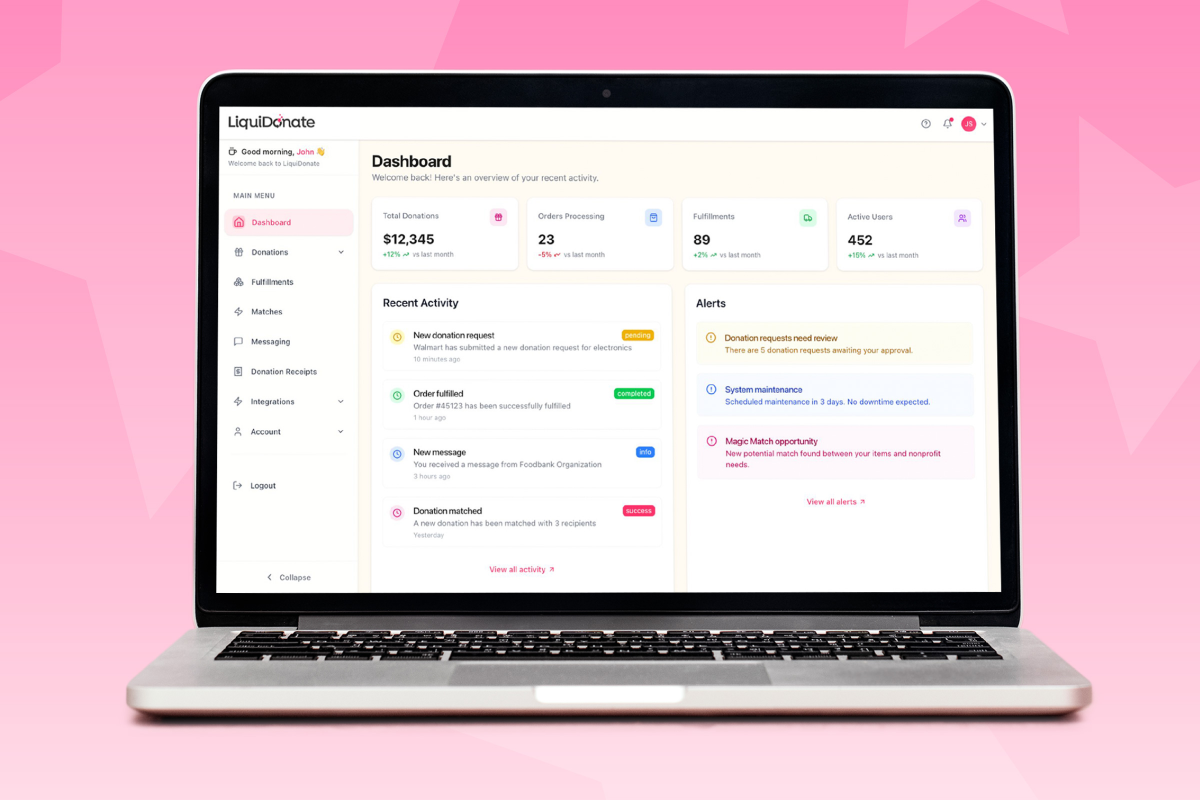
LiquiDonate handles unsellable inventory at both stages: what’s already sitting in your warehouse, and what’s still on its way back from customers.
Deadstock, excess, and returned inventory costs you in storage while it sits and in fees or lost value when you clear it out. WarehouseDirect by LiquiDonate routes it to the nearest vetted nonprofit instead, often netting more than liquidation once tax savings are included.
For returns that haven’t reached your warehouse yet, ReturnsDirect by LiquiDonate goes a step further. It intercepts unsellable returns at the point of customer return and routes them to a vetted nonprofit nearby. Instead of shipping a stained dress back to your warehouse, the Magic Match algorithm instantly finds a local organization that needs that item and generates a shorter-distance label.
The result: roughly 25% lower label costs, 75% shorter shipping distances, and automated tax donation receipts that document every item for your CFO.
LiquiDonate connects to a network of 5,000+ nonprofits across the US and Canada. The platform has already moved 16 million+ items worth an estimated $130 million in donated value.
LiquiDonate's SKU-level controls let you flag entire collections or individual styles for automatic donation. Seasonal items, samples with minor imperfections, and fit-related returns all get matched to the nearest qualifying nonprofit.
No warehouse re-handling. No landfill fees. No resale.
LiquiDonate features
- Optimized & Instant : Automatically pairs each return with a local nonprofit that needs that specific product category, cutting shipping distances by up to 83%
- SKU and collection-level routing: Set donation rules by product line, so your team decides which items skip the warehouse and which go back to stock
- Automated tax receipts: Every donation generates documentation for IRC Section 170(e)(3) deductions, worth up to 2x cost basis for qualifying C-corporations
- Shopify, Loop, and API integrations: Plugs into your existing returns portal with a quick setup call, no custom development required
- Brand protection controls: Nonprofits in the network agree not to resell donated items, keeping your brand off liquidation sites
- Impact reporting dashboard: Track pounds diverted, miles saved, and items donated per month for your sustainability reporting
- Disaster recovery distribution: Routes donated items to communities affected by natural disasters through established nonprofit partnerships
LiquiDonate pros and cons
Pros:
- LiquiDonate's 5,000+ nonprofit network is one of the largest donation-specific networks in North America, so your items reach organizations that actually need them
- Guaranteed no resale of items donated; trust that your items go to the nonprofit promised
- No contract minimums, no setup fees, and you can cancel at any time, which means you can test the platform on a single product line before scaling
- Recognized as a 2025 Best Invention by TIME, confirming the platform's position as an award-winning Donation Disposition Solution
- Dedicated support team that provides excellent customer service, to provide effective reporting and ensure your margins are protected
- Disaster relief deployments, including the July 2025 Texas floods, give brands a way to send inventory where it’s urgently needed, matched to nonprofits’ real-time needs so donations aren’t wasted
Cons:
- Currently focused on US, Canada, and the UK. European distribution is planned for late 2027/early 2028, so those doing business in the EU will need to wait.
Comparison table: The best returns donation software for fashion retailers
How does donation-first returns software reduce costs for fashion brands?
When a customer returns a garment that can't be restocked, the traditional path is expensive: ship it back to the warehouse, inspect it, store it, then pay to landfill or liquidate it. Each step adds cost with zero revenue recovery.
LiquiDonate’s donation-first software skips most of those steps. The item goes directly from the customer to a local nonprofit. That shorter route can cut label costs by 25% or more, eliminate warehouse re-handling fees, and generate a tax deduction that recovers a portion of the item's value.
According to the NRF's 2025 Retail Returns Landscape report, retailers expect roughly 15.8% of annual sales to be returned. For fashion, that percentage runs higher on online orders.
A mid-size apparel brand processing 5,000 unsellable returns per quarter could save tens of thousands in shipping and disposal fees by routing those items to nonprofits instead.
What should fashion retailers look for in an EPR-compliant donation platform?
Extended Producer Responsibility (EPR) regulations are expanding across the US, starting with California Senate Bill 707 (the Responsible Textile Recovery Act). These laws hold brands accountable for the full lifecycle of their products, including what happens after a return.
A donation platform that supports EPR compliance should include:
- End-of-life tracking: Document where each returned item ends up (donated, recycled, or otherwise diverted) so you can report to regulators
- Landfill diversion metrics: Quantify pounds diverted and items donated per reporting period
- Audit-ready documentation: Automated records that prove your brand is meeting diversion targets, not just claiming them
Fashion brands that build donation-first workflows now are positioning themselves ahead of compliance deadlines rather than scrambling to retrofit later.
Why LiquiDonate is the best returns donation software for fashion retailers
LiquiDonate is built specifically for the problem fashion retailers face with unsellable returns. The platform doesn't treat donation as an afterthought or a secondary disposition channel. ReturnsDirect By LiquiDonate intercepts returns at the moment a customer initiates them and matches each item to a nearby nonprofit using the Magic Match algorithm.
That donation-first architecture means your team isn't paying to ship garments back to a warehouse only to decide they can't be resold. LiquiDonate's case study results tell the story: 9,100+ items donated, 100,000+ miles of return shipping eliminated, and 34,639 pounds of textiles diverted from landfills across 22 cities in a single brand partnership.
If your operations team is looking to cut reverse logistics costs while building authentic ESG credentials, see how ReturnsDirect By LiquiDonate works or request a demo.
FAQs about best returns donation software for fashion retailers
What is returns donation software?
Returns donation software routes customer returns that can't be resold directly to nonprofits instead of sending them to a warehouse or landfill. LiquiDonate's ReturnsDirect, for example, matches each unsellable return with a local nonprofit and generates a shorter-distance shipping label automatically.
How do fashion retailers benefit from donating returns?
Donating returns cuts shipping costs, eliminates warehouse re-handling fees, and generates tax deductions worth up to 2x cost basis for qualifying C-corporations. LiquiDonate automates the entire process so your team spends less time on disposition decisions and more time on core operations.
Can returns donation software integrate with Shopify or Loop?
Some platforms integrate directly. LiquiDonate offers a dedicated Shopify app and a partner integration with Loop, plus API connectors for other returns portals. Setup starts with a quick onboarding call.
Does donating returns help with EPR compliance?
Donating returns contributes to landfill diversion targets that EPR regulations require. LiquiDonate tracks every donated item and generates documentation you can use for compliance reporting under frameworks like California's SB 707.
How does donation-first software prevent brand cannibalization?
LiquiDonate's nonprofit partners agree not to resell donated items on secondary markets. Your garments go to organizations that distribute them directly to people in need, keeping your brand off liquidation sites and discount marketplaces.