🗞️ Special Report: State of Retail Returns Fraud in 2026
Click Here to Read More


🗞️ Special Report: State of Retail Returns Fraud in 2026

Donate any loose or bulk warehouse excess quickly, affordably, and sustainably.










Set up your account in about 15 minutes with our success team. No downloads or deposits.
Enter the details of your excess or unsellable inventory. Donate by the item, box, pallet or truckload.
You can breathe a sigh of relief. That inventory piling up will be out of your hair within 7 business days and in the hands of people whose lives you just made better!
Book a Demo

Book a Demo
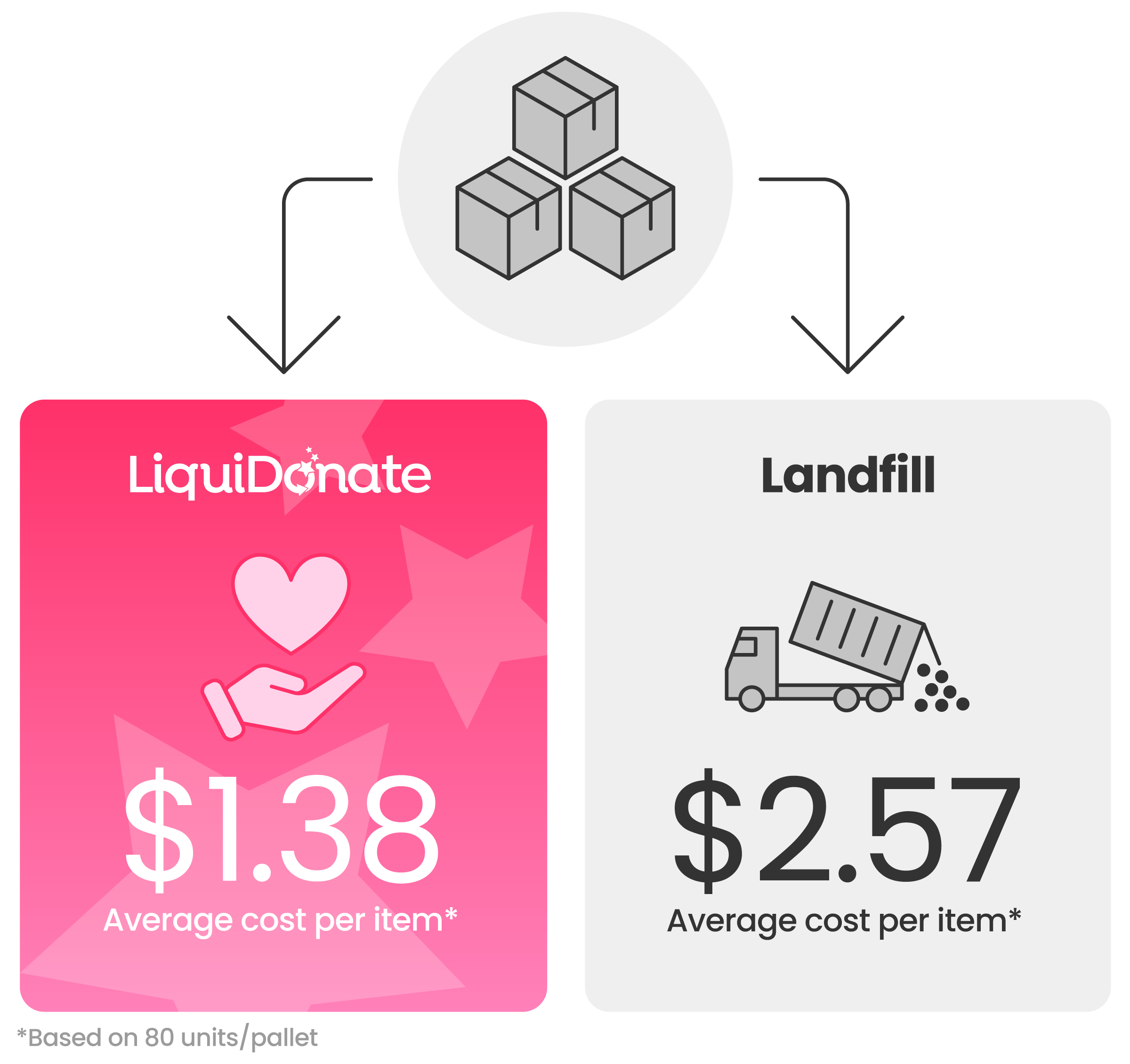
Landfilling or destroying warehouse excess costs money and hurts the environment.
Sustainable operations are no longer optional.
A recent Ernst & Young study found that price is just as important as sustainability among consumers buying luxury goods.
.png)
Reduce storage costs and gain tax benefits by donating surplus stock, accruing financial benefits when items cannot be resold.

$288 billion worth of unsold inventory gets sent to the landfill each year! Eliminate waste to help build the solution, not add to the problem.
Receive monthly reports and share your contributions with customers and stakeholders to help build brand, measure ESG goals, and more.
.png)
.svg)
The median liquidation recovery rate across all product categories is approximately 9% of retail value, according to Amplio's Q3 2023 Liquidation Auction Report. Apparel performs worst at 1.4–2% median recovery, with over 80% of auctions receiving zero bids. After processing costs, marketplace fees, and depreciation during selling cycles, most companies net very little from liquidation. There is also always the risk of hurting your brand reputation and customers online learning they can just wait to buy until liquidators get the inventory.
With LiquiDonate, you don’t have to worry about all of that. Donation eliminates the risk of brand dilution from products appearing on discount marketplaces. Not only can you protect your items from resale, but also you can seek tax rebates that may far outweigh the amount you would net from Liquidation. Many of our partners also can reduce customer churn and build loyalty by introducing LiquiDonate as a sustainability initiative and getting closer to zero waste goals.
So when it comes to Liquidation vs. LiquiDonate, it’s always better to donate.
The national average landfill tipping fee is $62.28 per ton according to the EREF 2024 Report–up 10% year-over-year. When including transportation costs (up to 60% of total reverse logistics cost), sorting, and brand-protection verification, total destruction costs typically range from $1–$8 per unit for consumer goods. Products with hazardous components (common in beauty/CPG) can cost significantly more under RCRA-compliant handling. There is zero financial recovery from destruction, compared with a potentially significant financial recovery from donation
LiquiDonate does not give tax advice, but we recommend looking up IRC Section 170(e)(3): C-corporations that donate inventory to qualified nonprofits can claim an enhanced deduction equal to cost basis plus half the unrealized appreciation, capped at twice the cost basis. At the 21% federal corporate tax rate, this can generate substantial tax savings for many organizations.. Always consult a qualified tax professional to confirm eligibility and deduction amounts for your specific situation.
Donation at scale requires real infrastructure: matching inventory to vetted nonprofits, coordinating fulfillment, generating tax documentation, and managing compliance. Without it, brands spend 3+ hours per week on coordination at an average cost of $360–$400/month in labor alone, before accounting for shipping, packaging, and paperwork. LiquiDonate's service fee covers all of that:, dedicated support, immediate nonprofit matching, fulfillment coordination, and impact reporting. And it is intentionally priced to cost less than liquidation, warehousing, or landfill disposal. Read more about why donation logistics isn't free from our CEO here.
Traditional liquidation channels (bulk buyers, off-price retailers, auction platforms, etc.) can move inventory fast but typically recover only 1-9% of retail value, often netting negative after processing fees.
Another issue is the risk of brand value and cannibalization. When customers find out they can get products at lower prices by waiting for the reseller, they are less likely to buy directly from the retailer.
A faster and more financially sound alternative is donation-based disposition: platforms like LiquiDonate match excess inventory to vetted nonprofits in under a week, generating tax deductions that typically outperform liquidation recovery entirely.
The most financially and environmentally sound option is donation. It generates a tax deduction under IRC Section 170(e)(3), keeps products out of landfills, and protects brand equity by keeping goods off discount marketplaces. Liquidation recovers only 1-9% of retail value on average, and landfill disposal costs $1-$8 per unit with zero financial return. Platforms like LiquiDonate automate the entire donation process, matching excess inventory directly to vetted nonprofits.
The key is having a clear disposition strategy before overstock accumulates, not after. One underutilized lever is handling returns better upstream: routing unsellable returns directly to nonprofits at the moment of return initiation, rather than back to a warehouse, prevents returned goods from quietly becoming overstock in the first place. For inventory that does pile up, donation consistently outperforms liquidation financially, generating tax deductions under IRC 170(e)(3) rather than accepting 1-9% of retail value from bulk buyers. LiquiDonate automates both paths: ReturnsDirect intercepts unsellable returns before they take a costly trip back to the warehouse, while WarehouseDirect moves existing overstock to vetted nonprofits with full tax documentation.
Yes, with some parameters. LiquiDonate accepts CPG products (but not perishables) past their "Use-By" date, which indicates peak quality, not safety. Per FDA guidance, products past this date remain safe and wholesome if stored properly, spoilage aside. We don't accept fresh produce. Nonprofit partners explicitly opt in to receiving past-date products, so every donation is matched to an organization that has agreed to receive it.
Unlike liquidation channels, where brand control effectively ends at the point of sale, LiquiDonate donates exclusively to vetted 501(c)(3) nonprofits who receive goods for direct community use, not resale. Every nonprofit in our network is screened and agrees to our terms of use. They also have to agree to retailer preferences, like not reselling, before they can receive items from that brand. That means your products go to people who need them, not back onto discount marketplaces where they can undercut your retail pricing or dilute your brand.
Selling a bulk amount of clothing through liquidation auctions usually means losing control of where it ends up. Apparel recovers under 5% of retail value on average, and lots often resurface on discount marketplaces, undercutting full-price sales and diluting the brand. Donating avoids both problems: there's no resale to track, and it qualifies for a tax deduction under IRC 170(e)(3). WarehouseDirect lets a brand enter a lot by box, pallet, or truckload and get matched with a vetted nonprofit in about seven days.
The biggest brand risk in moving excess stock is having it resurface on discount marketplaces, undercutting full-price sales and signaling oversupply to customers. Selling through tightly controlled outlet channels or B2B liquidators with no-resale clauses helps, but enforcement is hard to verify after the fact. Donating sidesteps the problem. Our WarehouseDirect service routes excess inventory to a vetted network of over 4,000 nonprofits, so the product reaches people who need it instead of ending up back on a resale shelf.
Liquidated inventory often resurfaces on discount marketplaces, which can undercut a brand's pricing and dilute its image. All LiquiDonate services avoid that by vetting every nonprofit partner before they're matched with inventory, screening out resellers so donated items go to organizations actually distributing goods to people who need them, not back onto the secondary market. Liquidation also often bring very limited revenue, sometimes pennies to the dollar! Most retailers can recoup through donation-based tax benefits.
No. This is one of the core differences between donating through ReturnsDirect and donating on your own. Local nonprofits and schools often can’t handle the volumes that are dropped off in bulk from retailers, so they end up selling them and then ultimately those items are sold as new on sites like marketplace or eBay. There are also bad actors out there trying to commit donation fraud. Using a vetted donation network like LiquiDonate means that the right items with the right quantities go to the organizations that need them most, and they also agree not to resell if that is what the retailer requires.

Contact us with any questions and a member of the team will get right back to you.
Contact Us










.png)