
Case Study
Turning Stranded Appliances Into Community Impact: Kenmore's Success Story

Table of contents

At a glance
When appliances strand at Last Mile Hubs, brands face a lose-lose: pay hundreds per unit to reverse ship, store, or dispose–with nothing to show for it. Kenmore ran a 45-day pilot with LiquiDonate to test a different model, donating 60 stranded appliances from 25 hubs across 20 states directly to 32 local nonprofits at an average distance of just 21.7 miles. The result was a total financial swing of up to $47,700 compared to traditional disposition, plus $57,000 in donated fair market value.
How a leading enterprise appliance brand redirected stranded inventory from Last Mile Hubs to local nonprofits in just 45 days.
Introduction
Kenmore, a leading national appliance brand with inventory distributed across a nationwide network of 3PL Last Mile Hubs faced a growing operational challenge: stranded appliances with no clear path forward. Failed deliveries, customer refusals, and order cancellations were leaving brand-new, fully functional units sitting idle in hubs across the country, accumulating storage costs and tying up resources.
By partnering with LiquiDonate, the brand transformed this costly problem into a triple win: operational savings, tax benefits, and meaningful community impact.
In a 45-day pilot spanning January 2026 – February 2026, LiquiDonate redirected 60 stranded appliances from 25 Last Mile Hubs across 20 states to 32 local nonprofit organizations—at an average delivery distance of just 21.7 miles.
The Challenge
When appliances get stranded at 3PL Last Mile Hubs, brands face a costly dilemma: reverse logistics, storage fees, and disposal costs stack up fast with zero return on the investment.
- Reverse Logistics: $213 per unit to ship appliances backward through the supply chain
- 3PL Storage: $50–$150+ per month while units sit idle in hubs
- Disposal Costs: $75–$200+ per unit for proper appliance disposal, including EPA-compliant refrigerant handling
- Total Traditional Cost: $338–$713+ per unit with $0 return
For this brand, the problem was compounding across 25 hubs in 20 states. There had to be a better way.
What if you could clear stranded inventory for a flat $250 per unit and receive a tax benefit that turns a net cost into a net gain?
The Solution
LiquiDonate’s WarehouseDirect solution transforms stranded inventory from a cost center into a community benefit and a financial advantage. Instead of paying to ship units backward through the supply chain, this leading appliance brand partnered with LiquiDonate to connect stranded appliances directly with local nonprofits near each Last Mile Hub.
How It Works
- Confirm Inventory – LiquiDonate confirms stranded units at each Last Mile Hub.
- Match Nonprofit – Matched with vetted local nonprofits from a 4,500+ network.
- Arrange Pickup – LiquiDonate coordinates logistics between the LMH and nonprofit.
- Provide Tax Docs – Donor receives full documentation for tax benefit qualification.
Why This Works for Appliance Brands Like Kenmore
- Eliminate Reverse Shipping: No $213+ per unit to ship appliances backward. Units move locally from LMH to nonprofit.
- Zero Storage Accumulation: Stranded inventory matched and moved in days, not months. No pallet fees stacking up.
- Tax Benefit Advantage: At $950 avg FMV per unit, C-Corp donors qualify for enhanced deductions under IRS 170(e)(3).
- Brand-Safe, Verified Donations: 4,5500+ vetted nonprofits ensure goods go to communities in need—not resellers or landfills.
- Scalable Across 3PL Networks: Pilot proved the model across 25 hubs in 20 states. LiquiDonate handles all coordination.
- ESG & Sustainability Impact: Every donated appliance stays out of a landfill. Measurable impact for stakeholder reporting.
Financial Comparison: The Numbers Tell the Story
Comparing traditional reverse logistics against LiquiDonate’s donation model reveals significant financial advantages, especially with the tax benefit available under IRS Section 170(e)(3) for C-Corporations donating to qualified nonprofits.
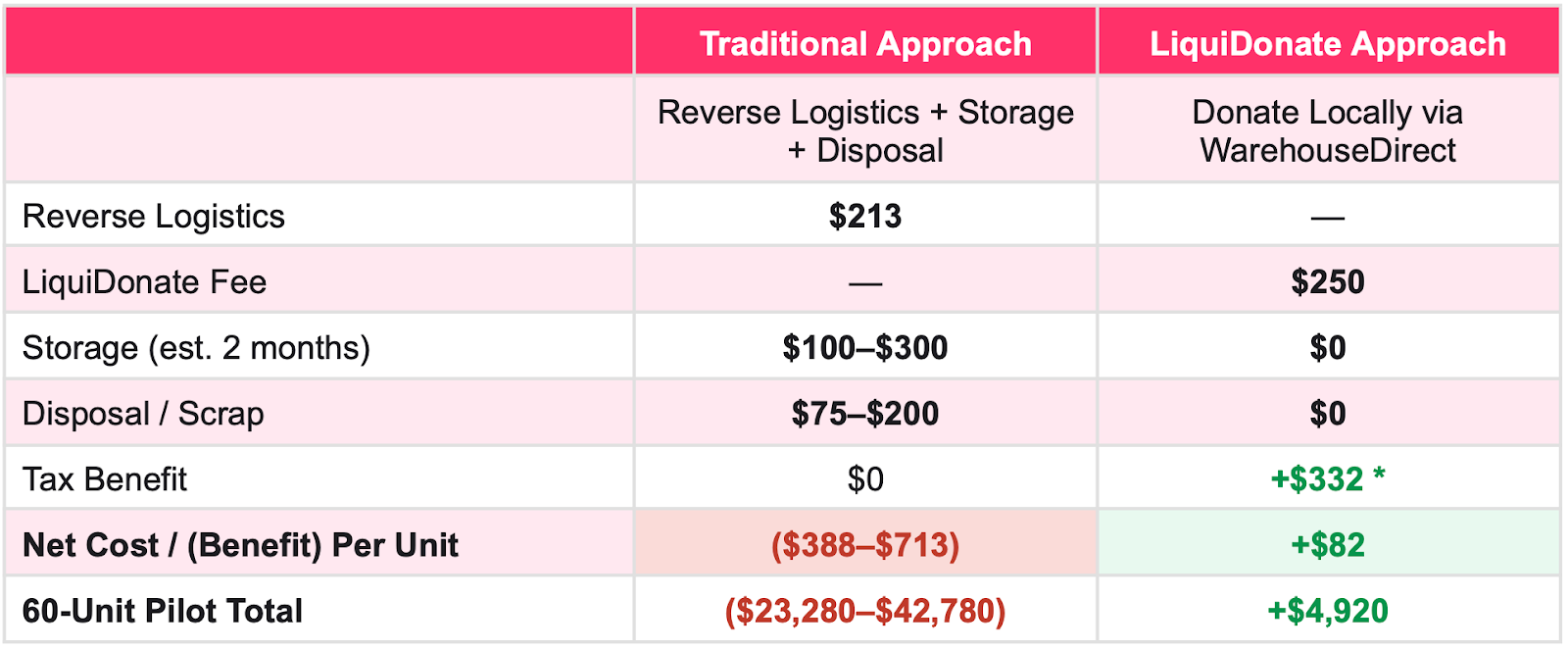
* Tax benefit calculated at $950 FMV under IRS Section 170(e)(3) enhanced deduction for C-Corporations.
Total Swing: Up to $47,700 better with LiquiDonate
From a worst-case cost of ($42,780) to a net benefit of +$4,920 across 60 units.
Savings At Scale
- 100 Units = $8,200 net benefit
- 500 Units = $41,999 net benefit
- 1,000 Units = $82,000 net benefit
Impact by the Numbers
Streamlined Logistics
- 60 Appliance Units Redistributed — kitchen appliances matched to nonprofits in need
- 25 Last Mile Hubs — inventory cleared from hubs across the country
- 20 States Covered — nationwide reach through local nonprofit matching•
- 21.7 Miles Average Distance — demonstrating highly localized redistribution
- 100% Donation Rate — every stranded unit was successfully placed
Community Benefits
- 32 Unique Nonprofits Served, including Habitat for Humanity, World Vision US, and community housing programs
- Top Populations Served: Families, individuals experiencing homelessness, youth, and community organizations
- $57,000 in Total FMV Donated — previously stranded inventory found a second life providing critical value to nonprofits
"The refrigerator was able to be utilized by the athletic dept, who will now begin keeping it stocked full of foods students can eat after practice. Many of our students will not eat at night so this was an amazing blessing to them and their families." - Kenmore donation recipient
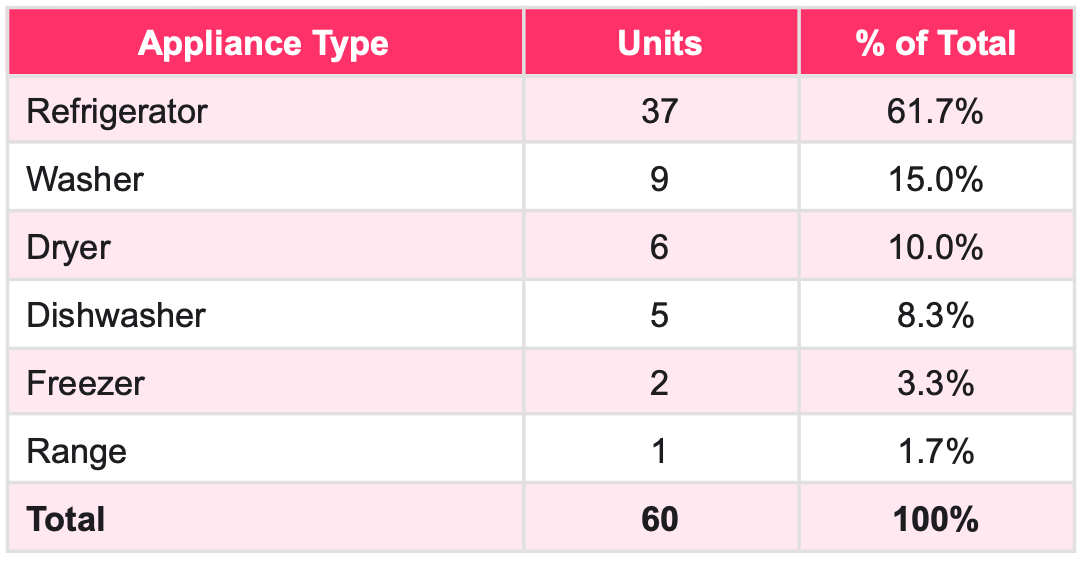
Inventory Breakdown
Challenges Addressed
High Cost of Reverse Logistics for Large Appliances
Shipping refrigerators and washers back to a central warehouse at $213+ per unit is expensive and logistically complex. LiquiDonate eliminated this entirely by keeping appliances local—average delivery was just 21.7 miles versus hundreds of miles for reverse shipping.
Stranded Inventory Accumulating Storage Costs
Every day a stranded appliance sits in a Last Mile Hub, it costs money—$50–$150+ per month per unit. With units scattered across 25 hubs in 20 states, the cumulative storage expense was significant. LiquiDonate’s rapid matching and delivery cleared units from hubs in days, not months, freeing up space and eliminating ongoing fees.
No Existing Donation Infrastructure
Kenmore had no prior process for donating inventory at scale across a distributed hub network. LiquiDonate provided the complete infrastructure—nonprofit vetting from a 4,500+ organization network, logistics coordination, BOL documentation, and tax substantiation—out of the box.
Disposal Costs and Environmental Concerns
Appliance disposal at $75–$200+ per unit, particularly for units containing refrigerants, carries both financial and environmental costs. By diverting 60 units from disposal to productive reuse, the program eliminated waste while supporting the brand’s ESG and sustainability objectives.
Key Takeaways for Big & Bulky Brands
- Donation Beats Disposal Financially: A $250 flat fee replaces $338–$713+ in traditional costs—and generates a +$82 net benefit per unit after tax savings.
- The Tax Benefit Is the Game-Changer: At $950 FMV, C-Corps receive +$332 per unit in tax benefits under IRC 170(e)(3)—more than covering the LiquiDonate fee.
- Hyper-Local Matching Minimizes Costs: An average delivery distance of 21.7 miles keeps final-mile costs low and turnaround fast.
- Scale Is Built In: The model works at 60 units and at 1,000+ At scale: +$82,000 in net benefits with $388K–$713K in traditional costs avoided.
- Community Impact Is Measurable: 32 nonprofits received working appliances, serving families, individuals experiencing homelessness, and community organizations nationwide. Big & Bulky items are rarely donated due to logistical costs, filling difficult need-gaps in the community.
Conclusion
In just 45 days, this pilot demonstrated that donating stranded appliances locally is operationally feasible across a distributed 3PL network—and financially superior to every traditional disposition method.
Kenmore successfully redirected 60 appliances from disposal to productive use, served 32 nonprofits across 20 states, and generated a net benefit of +$4,920—a total swing of up to $47,700 compared to the traditional disposal pathway.
LiquiDonate’s WarehouseDirect solution handled the entire process—from inventory confirmation to nonprofit delivery to tax documentation—requiring no new infrastructure from the brand. The result is a scalable, repeatable model that turns a cost center into a source of savings, tax benefits, and measurable community impact.
Ready to Clear Your Stranded Inventory?
Book a demo here, email sales@liquidonate.com or call (510) 629-1541.
Financial projections are estimates based on industry averages and pilot data. Tax benefits depend on individual corporate circumstances and should be verified with a qualified tax advisor. IRS Section 170(e)(3) enhanced deductions apply to C-Corps donating inventory to qualified 501(c)(3) organizations. Storage and disposal cost ranges reflect typical industry pricing for large appliances.
Download Case Study File

Try LiquiDonate for a seamless, cost-effective, and brand-safe solution to unsellable inventory
Contact us with any questions and a member of the team will get right back to you.
Contact Us


